New York City
The Running ManNew York City functions in Ben Richards’s flight as a city of apparent disappearance that never becomes a place of true safety. He reaches it by air after leaving Boston, enters its immense urban anonymity, and takes shelter in the Brant Hotel, but the city’s scale only gives temporary cover. Its inner divisions, transport infrastructure, and media circulation reproduce the inequalities and political pressures from which he is running.
Arrival and Temporary Refuge
New York City enters the narrative as an impulsive destination. After leaving the Boston Y.M.C.A., Ben Richards crosses the Canal, finds a cab among late-night traffic, and tells the driver to take him to the airport. He buys a ticket to New York City almost because the name comes naturally to mind. The flight is a speed shuttle carrying roughly forty passengers, mostly sleeping businessmen and students; an Airline Police officer dozes in the observation opening throughout the journey, and Richards himself sleeps for part of the trip. He lands at 3:06 and leaves the airport without incident.
The city initially appears to absorb him. At 3:15, a cab carries him down the Lindsay Overway and diagonally across Central Park, and at 3:20 Ben Richards disappears into what the narration calls the largest city on the face of the earth. The wording makes urban size a tactical resource: New York City can hide a wanted man not through protection or solidarity, but through the sheer quantity of streets, strangers, vehicles, and rooms available to him.
He goes to earth at the Brant Hotel on the East Side, a merely adequate establishment in an area beginning a new cycle of chic. The hotel is less than a mile from Manhattan’s blighted inner city, also described as the largest in the world. That proximity establishes the city’s defining spatial contradiction. Fashionable renewal and vast urban ruin exist almost side by side, while Richards carries Dan Killian’s warning to stay close to his own people as he registers under the name John G. Springer.
A City Divided by the Canal
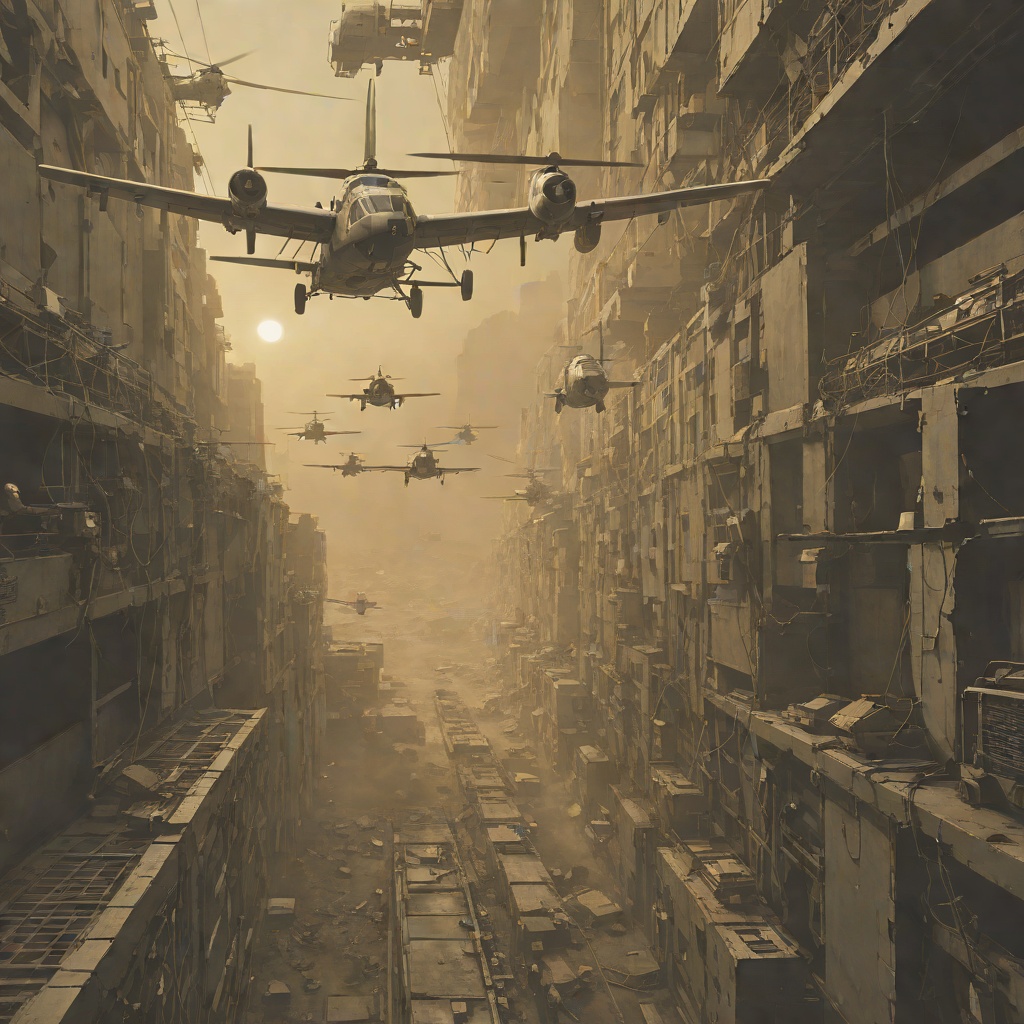
The social geography surrounding New York City is prepared by the landscape south of the Canal. Co-Op City is presented as a radiating rat warren of parking lots, deserted shops, Urban Centers, and paved playgrounds. Police rarely venture into the district; cycle gangs enforce their own law, and the official reports about the Block Police of South City are dismissed as propaganda. The streets are silent and dangerous, and anyone going out must use a pneumo bus or carry a gas cylinder.
This southern district is not simply poor in an abstract sense. Its physical details register the consequences of abandonment: a stripped 2013 Humber rests on decayed axles, garbage spills across sidewalks and gutters, rats move through the streets, and sodium lights installed by General Atomics in the 1970s remain broken because no technico will replace them there. Richards walks rather than take a pneumo bus because his twenty-dollar weekly unemployment allotment in oldbucks has already been spent and he cannot afford a token. His poverty becomes visible enough to be sensed by the roaming packs, even though he is not attacked.
The Canal marks a material and political threshold. South of it, Co-Op City has four million residents, almost all unemployed, while Free-Vee cables lie safely buried beneath the streets and the dream machine operates continuously on the other side. Free-Vee is available without payment, but the New Dollars required for life beyond the Canal belong only to employed people. When Richards crosses the Canal, the city changes immediately: expensive movie houses and ungrilled smoke shops replace the heavily protected shops of the southern district, Rent-A-Pigs stand outside, city cops occupy every corner, and even a small public park charges admission while police guard its gate.
The Games City
The Network Games Building dominates the northern skyline. It rises one hundred stories, with its upper half buried in cloud and smog, and becomes Richards’s fixed visual target as he walks toward the qualifying examinations. The line of applicants stretches for more than a mile and nine blocks from the building, forming an “eternal snake” beneath the watching police. The Games therefore convert the city’s class geography into a procession: men from the excluded districts move toward the institution that will commodify their desperation.
New York City also becomes the setting in which Richards is converted into a public image. In the Network Games Building, a hidden-camera portrait of him is retouched to deepen his eyes, lower his forehead, darken his cheeks, and give his mouth a curled, jeering expression. The resulting figure is presented as an urban boogeyman, an apparently primitive and dangerous man from south of the Canal. His body and origin are turned into a visual argument about the threat posed by the city’s poor.
The same process is applied to Sheila Richards. During the television presentation, a manipulated still of her transforms her face into that of an avaricious and sexually degraded woman. The broadcast promises that the prize associated with Ben Richards will go to her if he is captured, while a verified sighting is assigned a reward of one hundred New Dollars and a killing a reward of one thousand. New York City is thus not merely the place where the Games are headquartered; it is the urban market in which surveillance, humiliation, family danger, and entertainment are made exchangeable.
Media, Mobility, and Pursuit
The city’s infrastructure enables both concealment and control. Richards can move from Boston to New York City on a fast shuttle, cross Central Park by overway, and enter a hotel under a false identity. Yet the same networked society can circulate his face across the country. The television program uses still images, hidden-camera footage, altered photographs, and edited clips to impose a narrative in which he is a killer and an enemy of public order.
When Bradley Throckmorton later watches the lead-in to The Running Man, Bobby Thompson stares from a brilliant post surrounded by darkness and introduces Richards as a wolf among ordinary people. A blowup of Richards’s face is followed by an image of him in disguise. The broadcast links him to the deaths of five policemen at the Boston Y.M.C.A. and asks where he is now, turning geographical uncertainty into a national spectacle. The city that once hid him for a few hours is simultaneously rendered legible through broadcast images.
The propaganda becomes more aggressive as the program presents manipulated clips of Richards calling for violence and frames him as someone who would mobilize malcontents to rape, burn, and overturn the streets. It then displays the faces of young policemen and plays Taps. The structure excludes competing explanations and replaces Richards’s own account with a moral drama of innocent officers, a monstrous fugitive, and a threatened public. New York City’s media apparatus therefore extends the physical hunt into the homes of two hundred million viewers.
Urban Ruins and the Wider Escape Route
The city’s pattern of renewal beside abandonment recurs later in the landscape of the Super Pine Tree Mall. The unfinished development lies beyond a sign warning trespassers to keep out, and construction appears to have stopped at least two years earlier. Its half-built stores, discarded pipes, cinderblocks, boards, shacks, rusted Quonset huts, and overgrown vegetation form a maze stretching for miles. Foundation holes resemble graves, steel frames stand as skeletons, and intended parking lots have become grassed-over expanses.
Although the Super Pine Tree Mall is not central New York City, it belongs to the same metropolitan order: infrastructure is begun, marketed, and then abandoned, leaving behind a landscape in which escape and entrapment share the same physical form. Richards and Elton Parrakis use the unfinished complex as a hiding place while police and crowds close in elsewhere. The mall’s failed commercial promise echoes the city’s broader contrast between polished zones, blighted districts, and spaces left outside effective public care.
That contrast reaches its most militarized form at Voigt Airfield. The access road is lined with police cars and a shouting crowd; an electrified cyclone fence crosses the field, and an A-62 tank blocks the main gate with a cannon capable of firing quarter-megaton shells. Information booths, terminals, parking lots, and a control tower organize the airport as a controlled threshold, while a Lockheed/G-A Superbird climbs behind the buildings. The scene shows how metropolitan mobility can become a security spectacle: air travel promises escape, but every route is surrounded by surveillance, weaponry, crowds, and institutional force.
Narrative Significance
New York City concentrates the book’s spatial logic. It is immense enough to make disappearance possible, yet divided enough to expose the traveler’s class position at every crossing. Co-Op City offers abandonment and cheap media; the districts north of the Canal offer police density, commercial polish, and the Games; the Brant Hotel offers a temporary name and room; the airport offers movement under official inspection. Each space gives Richards a different kind of visibility, but none releases him from the systems that classify and pursue him.
The city also clarifies the relation between physical space and public narrative. Richards can vanish into New York City at 3:20, but the Network can make his face visible everywhere through altered photographs and edited footage. Later, Dan Killian claims that the Network had nothing to do with the deaths of Sheila Richards and Catherine Sarah Richards, calling them a horrible accident; Richards suspects the account sounds too much like a lie not to contain truth and knows that returning to Co-Op City would let him discover the facts. New York City consequently remains both a refuge and a route back toward the social reality the Games attempt to conceal.